Short answer: deep tissue massage is slow, firm bodywork that moves through the outer muscle layer to reach the fascia and trigger points underneath. At TAO in Vienna it is booked in 30, 60, 90 or 120 minute blocks, and 60 minutes at $100 is the most common choice. One visit buys roughly 3 to 7 days of relief; 4 to 6 weekly visits are where chronic patterns actually start to change.
Deep tissue massage works by shearing fascial adhesions, releasing myofascial trigger points, and down-regulating the stress response. A single 60-minute session typically delivers 3 to 7 days of relief; meaningful change in chronic patterns shows up around the 4 to 6 session mark with weekly cadence. TAO Therapeutic Massage Spa in Vienna, VA (8292 Old Courthouse Rd, minutes from Tysons Corner) offers deep tissue at $60 / $100 / $150 / $200 for 30 / 60 / 90 / 120 minutes. 5- and 10-session prepay packages start at $450. Open every day 10am–9pm. (703) 906-0992.
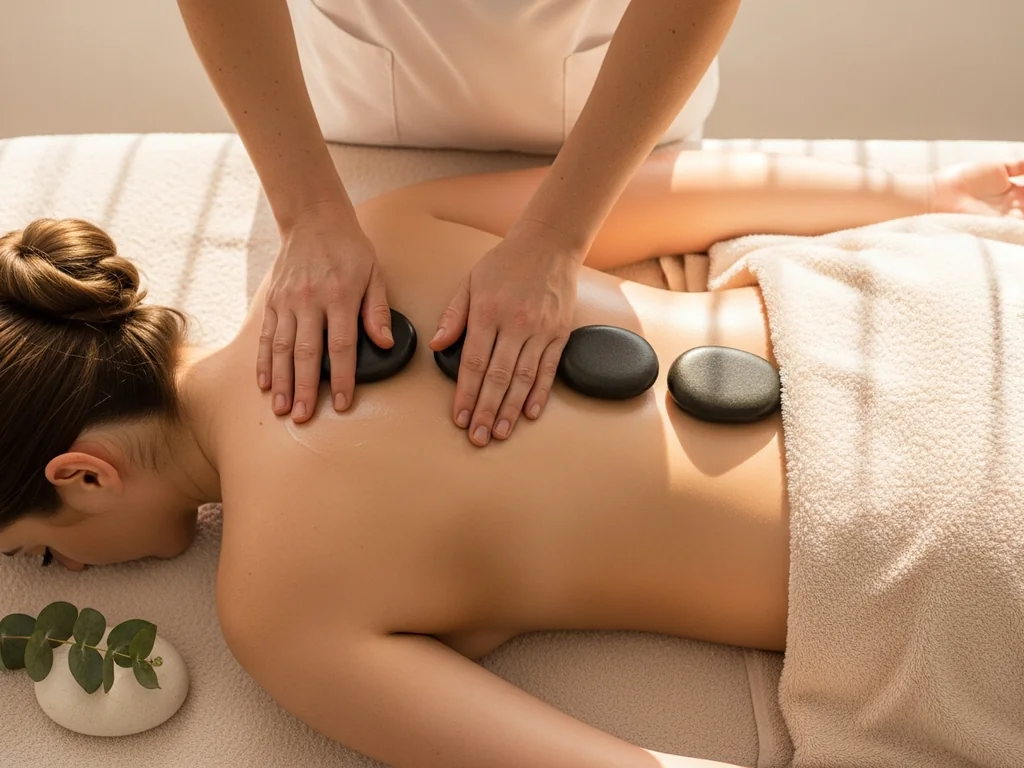
What Deep Tissue Massage Actually Is
Most articles about deep tissue massage online read like marketing copy. They promise stress reduction, posture correction, and improved circulation as if every session is a guaranteed cure-all. The reality is more useful — and more interesting. Deep tissue is a specific, well-studied modality with real mechanisms behind it, real conditions it helps, and real situations where it is the wrong choice.
This guide is written for someone trying to decide whether deep tissue is right for them, or whether to keep going after the first session. It covers how the technique actually works, the benefits worth caring about, what to realistically expect, when not to book it, and how we run deep tissue at TAO Therapeutic Massage Spa in Vienna, just minutes from Tysons Corner.
How Deep Tissue Actually Works on Your Body
Three things happen during a real deep tissue session, and they are worth understanding because they shape what to expect afterward.
First, fascia and connective tissue release. Fascia is the thin web that surrounds every muscle and organ. When it gets stuck — from chronic tension, old injury, or hours at a desk — it restricts movement and creates the feeling of being "tight all over." Slow, sustained strokes warm the fascia and break apart adhesions between tissue layers. This is the slowest part of the work and the reason deep tissue strokes are not fast.
Second, trigger-point release. A knot is a small band of muscle fibers stuck in contraction. Sustained direct pressure — often 30 to 90 seconds — temporarily restricts blood flow to the area; when the therapist releases, fresh blood floods back in and the contraction band relaxes. That sensation of "ow, ow, oh that is actually better" is the trigger-point release working in real time.
Third, nervous-system down-regulation. Sustained pressure within 20 to 30 minutes shifts your autonomic nervous system out of sympathetic (fight-or-flight) into parasympathetic (rest-and-digest). Heart rate drops. Cortisol drops. The mental clarity people report after a 90-minute session is not magic — it is a system that has finally been allowed to downshift.
Note what is not on this list: lactic-acid flushing. That phrase shows up in old wellness writing but the science does not really support it as a meaningful effect — lactic acid clears on its own within a few hours of training. The real recovery benefit comes from improved local circulation, lymphatic flow, and reduced delayed-onset muscle soreness.
What Deep Tissue Actually Delivers
1. Chronic Pain Relief — The Real Mechanism Most chronic muscle pain is not actually a muscle problem. It is a fascia and connective-tissue problem — adhesions form between layers that should glide freely, restricting movement and trapping nerves and small blood vessels. Slow, sustained deep-tissue strokes warm and shear those adhesions apart so the layers can slide again. That is why the relief from a good 60-minute deep tissue session can outlast the session by days or weeks, rather than wearing off in an hour like a quick relaxation rub.
2. Knot Release Through Trigger-Point Pressure A muscle knot — clinically, a myofascial trigger point — is a small band of muscle fibers stuck in contraction. Direct sustained pressure (usually 30 to 90 seconds per point) starves the area of oxygen briefly, then a rush of fresh blood comes in when the therapist releases. That cycle is what actually undoes the knot. It is also why deep tissue sometimes feels uncomfortable in the moment and significantly better fifteen minutes later.
3. Posture and Movement Patterns Reset If you sit at a desk in Tysons all week, your hip flexors shorten, your upper traps lock up, and your thoracic spine stops rotating. Stretching helps a little. Deep tissue work, applied over a series of sessions, actively lengthens the shortened tissue and rebalances the chains that pull you out of alignment. Most clients see meaningful posture change between weeks 4 and 6 of consistent work — not from any single session.
4. Recovery Acceleration for Training After hard training, lactic acid clears within a few hours — that part of the mythology is overstated. What deep tissue actually does for recovery is improve local circulation, reduce delayed-onset muscle soreness, and help the lymphatic system flush metabolic byproducts. Runners who add a 60-minute Deep Tissue every two weeks tend to report faster turnaround between hard sessions and fewer overuse niggles.
5. Stress Hormone Down-Regulation Sustained deep pressure activates the parasympathetic nervous system within the first 20 minutes of a session — heart rate drops, cortisol falls, and your body shifts out of the chronic low-grade fight-or-flight state most desk workers live in. The physical work and the nervous-system reset are inseparable. This is why you can walk out of a 90-minute session physically tired and mentally sharper than you have felt in weeks.
6. Improved Circulation Where It Matters Most Deep tissue strokes mechanically pump blood through compressed areas — the muscles around the upper traps, the lumbar erectors, the IT band — where capillary flow tends to stall under chronic tension. More oxygen and nutrients reach the tissue, more waste leaves. Over a series of sessions this is part of why old areas of stiffness start to feel less brittle.
7. Old Injuries Move Better Over Time Scar tissue from old strains, surgeries, or ankle sprains never goes away on its own. It just sits there, restricting movement years after the original injury. Deep tissue work can soften and reorganize that tissue gradually — not overnight, but meaningfully across 8 to 12 sessions. Clients regularly report that an area they had written off as permanently tight finally starts moving again.
8. Sleep Quality Lift in the First 24 Hours Probably the most reliable benefit, and the one clients comment on most. The combination of nervous-system down-regulation, reduced physical tension, and increased serotonin tends to produce noticeably deeper sleep the night of the session. Especially helpful for clients dealing with insomnia tied to chronic upper-back tension.
What Is Actually Realistic — and What Is Not
One session will give you 3 to 7 days of feeling better. It will not fix a chronic pain pattern that took you years to build. Results compound across 4 to 6 weekly sessions; that is the realistic timeline for changing how your body holds tension. After the initial series, most clients shift to every 2 to 4 weeks for maintenance.
Some post-session soreness is normal — similar to the day after a moderate workout. Mild tenderness at the deepest work areas can last 24 to 48 hours. What is not normal: significant bruising, sharp pain, or soreness that lingers past two days. Tell us if that happens; the pressure was likely too much and we will adjust next visit.
Drink water afterward. Avoid heavy training the same day. Skip alcohol if you can — both compound the dehydration that comes from any deep bodywork. None of this is rigid. It just helps you get the most out of the session.
When Deep Tissue Is the Right Pick — and When It Is Not
Book deep tissue if you have chronic muscle pain, a desk-job tension pattern (rounded shoulders, locked traps, tight hip flexors), an old injury that still flares, training-related stiffness, or you are an athlete using massage as part of your recovery plan. The 60- or 90-minute session is the right starting point for most of these cases.
Do not book deep tissue if you are on blood thinners (bruising risk), have acute inflammation from a fresh injury (let the area settle for at least 72 hours first), have a clotting disorder, a recent fracture, certain skin conditions like active eczema or open wounds in the treatment area, or you are in the first trimester of pregnancy. Mention any of these at booking so we can redirect you to a Swedish massage or Reiki session instead — both still help without the deep mechanical load.
Unsure? Try the TAO Signature Combo — your therapist starts with Swedish flow to read your body, then escalates to deep tissue only in the areas that need it. It is the safest first-visit choice for people who are not sure how their body will respond. For runners and weekend athletes, the Sports Massage ($120/60min) blends deep tissue with stretching and is often a better fit than pure deep tissue. For a broader read on choosing styles, see the TAO Massage Styles Guide.
Deep Tissue at TAO — The Practical Details
Deep Tissue at TAO is $60 for 30 minutes, $100 for 60, $150 for 90, $200 for 120. Every session is delivered by one of our five certified senior-level therapists — same names visit after visit, so your therapist learns where you hold tension and can pick up where the last session left off. That continuity is the part the chain studios cannot match, and the part that drives most of our 4-to-6-week results.
The pressure is dialed in at the start of every session and adjusted in real time. We ask about preferred pressure, problem areas, and what you want to leave the table feeling. Most clients lean somewhere between a 6 and an 8 out of 10 on pressure. We do not have a house style — we have a house standard, which is that the work matches what your body asks for that day.
For clients ready to commit to a series, the prepay packages save real money: 5 × 60-minute for $450 (save $50), 10 × 60-minute for $890 (save $110), 5 × 90-minute for $700 (save $50), 10 × 90-minute for $1,390 (save $110). Sessions are mix-and-match across Swedish, Deep Tissue, and the TAO Signature Combo, so you are not locked into one modality for ten visits.
The studio is at 8292 Old Courthouse Rd Ste C in Vienna, easy from McLean via Route 123 (~10 min) and Falls Church via Route 7 (~12 min). For directions and area-specific drive times, see the McLean and Falls Church location pages.
Deep tissue is not a quick fix or a magic reset — it is a steady, mechanical, evidence-backed way to undo chronic tension over a series of sessions. One visit gives you a week of relief. Four to six visits start to change how your body holds tension. Ten visits, plus a sensible cadence afterward, is what real chronic-pain improvement looks like. Call (703) 906-0992 or book online at book.squareup.com — start with a 60-minute and see what your body tells you.